
Contents:
US DEVELOPMENTS:
1. “STEALTH MANUFACTURING BOOM”? LOOK AGAIN: “No America is Not in a Stealth Manufacturing Boom”
2. CAR DECLINE: “Explaining the Relative Competitive Decline of America’s Automotive Industry”
3. SEMICONDUCTORS - 3 INTEL STORIES:
a) “How Intel Stock More than Doubled Last Month”
b) “Intel Bets Billions on Chip Packaging to Win AI Race”
c) “TSMC Warns of Intel Foundry’s Growing Prowess During the Company’s Latest Earnings Call”
4. REACTION SETS IN FOR DATA CENTERS: “The Mood in the US is Turning Against Data Centers”
5. ELECTRIFICATION OF THE ECONOMY RUNS INTO GRID BUILDOUT: “The Constraints on American Power Supply are Crippling”
EUROPE DEVELOPMENTS:
6. EU COMPETITIVENESS CHALLENGE WITH THE US: “Eurosclerosis 2.0”
7. FRANCE WONDERS HOW TO COPE WITH CHINA’S INDUSTRIAL EXPANSION: “In an Impressive Array of Technologies and Sectors, Beijing has Caught Up with and Surpassed the West, Seeking, in Each Case, to Control the Entire Value Chain” (Part 2); “In Thirty Years, China’s El Dorado Has Turned into a Trap for Europe” (Part 4)
8. EU EFFORTS TO RUN A COHERENT GREEN INDUSTRIAL STRATEGY HAVE FEW RESULTS: “Europe’s Resistance to Chinese Investment Has Stalled”
CHINA DEVELOPMENTS:
9. CHINA-US TECH SCORECARD: “State of Competition,”CHINA SHOCK 2.0: “China Shock 2.0; The Flood of High-Tech Goods that Will Change the World”
10. ENGINEERING EDUCATION IN CHINA: “The Giant Leap in the Development of Higher Engineering Education in China”

US DEVELOPMENTS:
1. “STEALTH MANUFACTURING BOOM”? LOOK AGAIN
“No America is Not in a Stealth Manufacturing Boom,” Noah Smith, Noahpinion, April 21, 2026
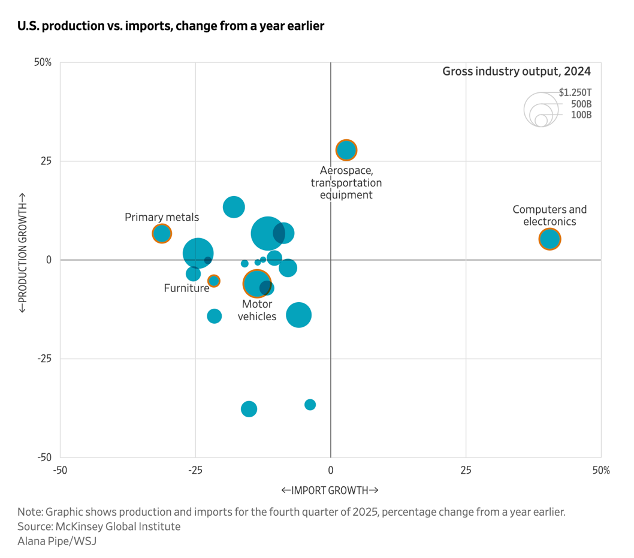
On April 19, the Wall Street Journal ran a story arguing that there was a “stealth manufacturing boom” in the US (https://www.wsj.com/economy/america-is-in-the-middle-of-a-stealth-manufacturing-boom-af0702af). It noted that “Since January 2025, manufacturing jobs have indeed fallen by about 100,000 workers, or roughly 0.6%. In the same period, though, manufacturing production rose 2.3%, and manufacturing shipments, unadjusted for inflation, climbed 4.2%.” But you do have to adjust for inflation. As economist Noah Smith puts it, “shipping more dollars of stuff doesn’t indicate a boom if the dollar is worth much less.” Instead, the Federal Reserve producer price data, inflation adjusted, shows a picture of continuing, decades long stagnation in American manufacturing. And factory spending is actually way down under Trump after soaring during Biden’s term.
With the exception of the semiconductor and aerospace sectors, US production verses imports is down (Q4 2024 to 2025) for US manufacturing sectors:
Excerpted with edits (paywall): https://www.noahpinion.blog/p/no-america-is-not-in-a-stealth-manufacturing
2. CAR DECLINE
“Explaining the Relative Competitive Decline of America’s Automotive Industry,” Stephen Ezell and Meghan Ostertag, ITIF, April 20, 2026
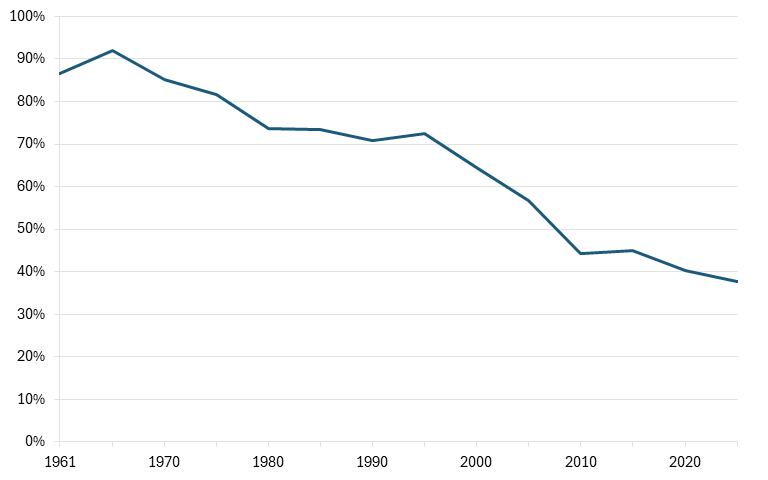
There are several causal factors behind U.S. auto industry decline, including risk aversion, product life cycle dynamics, structural changes in production processes from flexible to dispersed parallel systems, and management use of relational contracts.
· While all these factors contributed, the main issue driving the industry’s relative decline in the late 20th century was that it took 10–15 years for the Big Three to learn, adopt, and implement lean production techniques Japanese competitors used.
· The entrenched dominance of the U.S. mass production system would leave U.S. automakers ill-prepared when the onslaught of the Japanese automakers’ lean production system would arrive in the later decades of the 20th century.
· From 1967 to 1980, Japanese automakers increased their labor productivity by 7.9 percent per year, while for U.S. auto manufacturers, the rate of increase was just 1.3 percent.
· Today, the U.S. auto industry faces a new set of globalization challenges, marked by the offshoring of production to Mexico and the rise of China’s auto industry.
· Mexico’s most significant comparative advantage is wages. Adjusted for PPP, Mexican wages per auto worker were, on average, 25 to 30 percent of those in the United States from 2000 to 2021.
· From 2003 to 2023, China experienced a nearly 300 percent increase in its share of global automotive production, while the United States experienced a 39 percent decline.
Big three US automakers share of US market (cars and light trucks), 1961-2024
Excerpted with edits: https://itif.org/publications/2026/04/20/explaining-the-relative-competitive-decline-of-americas-automotive-industry/
3. SEMICONDUCTORS - 3 INTEL STORIES
A) “How Intel Stock More than Doubled Last Month,” Anders Bylund, Motley Fool, May 4, 2026
Intel shares rose 114.1% in April 2026. Why? Market analysts argue:
1) Intel’s Foundry-branded chip manufacturing services scored a couple of wins. The unit signed a long-term partnership with Tesla making Intel a founding partner of the upcoming Terafab chip-making facility (although details were vague). At the same time Alphabet committed to using Intel Xeon processors and jointly developed accelerators in Google Cloud’s AI operations. [In addition, on May 8 Apple and Intel confirmed a preliminary agreement for new iPhone chips, although details were not available on whether these involved Intel’s advanced 14A or 18A chips - see: https://www.eetimes.com/apple-intel-foundry-deal-could-reshape-u-s-chip-manufacturing/.]
2) Intel beat Wall Street’s targets in its first-quarter report. Revenue grew 7% year over year to $13.6 billion while earnings swung to an adjusted profit of $0.29 per share. Analysts had expected earnings near $0.02 per share on sales in the neighborhood of $12.4 billion. The Data Center and AI division posted 22% revenue growth; Foundry sales increased by 16%.
3) Finally, Intel confirmed that demand for AI chips is so high that customers are paying top dollar for chips that failed parts of the quality testing. The company can disable chip sections with significant manufacturing errors and still find customers willing to pay a premium for the working sections.
Excepted with edits: https://www.fool.com/investing/2026/05/04/how-intel-stock-more-than-doubled-last-month/
B) “Intel Bets Billions on Chip Packaging to Win AI Race,” Tech Buzz, April 6, 2026
Intel is making a massive bet that the next phase of phase of the AI boom won’t be won by the flashiest chips, but by how you put them together. The semiconductor giant is going all-in on advanced chip packaging - the unglamorous but critical process of assembling multiple chips into a single powerhouse processor.
As AI models balloon in size and demand skyrockets for compute power, Intel sees packaging as the bottleneck that could either strangle or supercharge the industry’s growth. The company is pouring billions into what industry insiders call the “forgotten middle” of chipmaking - the intricate art of binding multiple processors, memory chips, and components into a single package that actually works.
The company has quietly built out some of the most advanced packaging facilities in the world, capable of stacking chiplets with microscopic precision and connecting them with speeds that rival chips etched on a single piece of silicon. According to industry analysts tracking the semiconductor supply chain, Intel’s packaging technology is now two to three years ahead of most competitors in certain specialized techniques.
Advanced packaging is brutally difficult to scale. It requires nanometer-level precision across components made by different manufacturers, on different timelines, using different materials. One misalignment and your multi-billion-dollar AI chip becomes a very expensive paperweight. Intel has spent years perfecting techniques like EMIB (Embedded Multi-die Interconnect Bridge) and Foveros 3D stacking to solve these problems. The market Intel is chasing is staggering. Some estimates put the advanced packaging market at over $50 billion by 2028, growing at nearly 25% annually if AI infrastructure buildouts accelerate.
Excerpted with edits: https://www.techbuzz.ai/articles/intel-bets-billions-on-chip-packaging-to-win-ai-race
C) “TSMC Warns of Intel Foundry’s Growing Prowess During the Company’s Latest Earnings Call,” Anton Shilov, Tom’s Hardware, April 17, 2026
Intel is now ramping up production of client Core Ultra 3-series ‘Panther Lake’ and data center Xeon 6+ ‘Clearwater Forest’ CPUs at its Fab 32 in Arizona using its 18A fabrication process (1.8 nanometer (nm)-class advanced chips) that relies on gate-all-around RibbonFET transistors and boasts a backside power delivery network called PowerVia. While TSMC’s N2 production is now ramping at two fabs and also uses GAA nanosheet transistors, it does not support backside power delivery, and won’t until at least late in the year, which makes Intel’s technology somewhat more progressive, at least for some designs.
When it comes to revenue from chip production and packaging (and associated services), TSMC earned $33.731 billion in Q4 2025, whereas revenue of Intel Foundry was $4.5 billion, which makes Intel Foundry the world’s second-largest foundry, but a long way off first place.
It remains to be seen whether Intel’s 14A process technology (1.4nm class cutting-edge chips) will gain traction with external customers and whether the company will ever have production capacity comparable to that of TSMC. Yet, at this point, there are only three companies in the world — Intel, Samsung, and TSMC — that still have ambitions and the capability to produce logic chips on leading-edge process technologies, which is a reason why TSMC calls Intel a formidable rival.
4. REACTION SETS IN FOR DATA CENTERS
“The Mood in the US is Turning Against Data Centers,” Adam Tooze, Chartbook, April 26, 2026
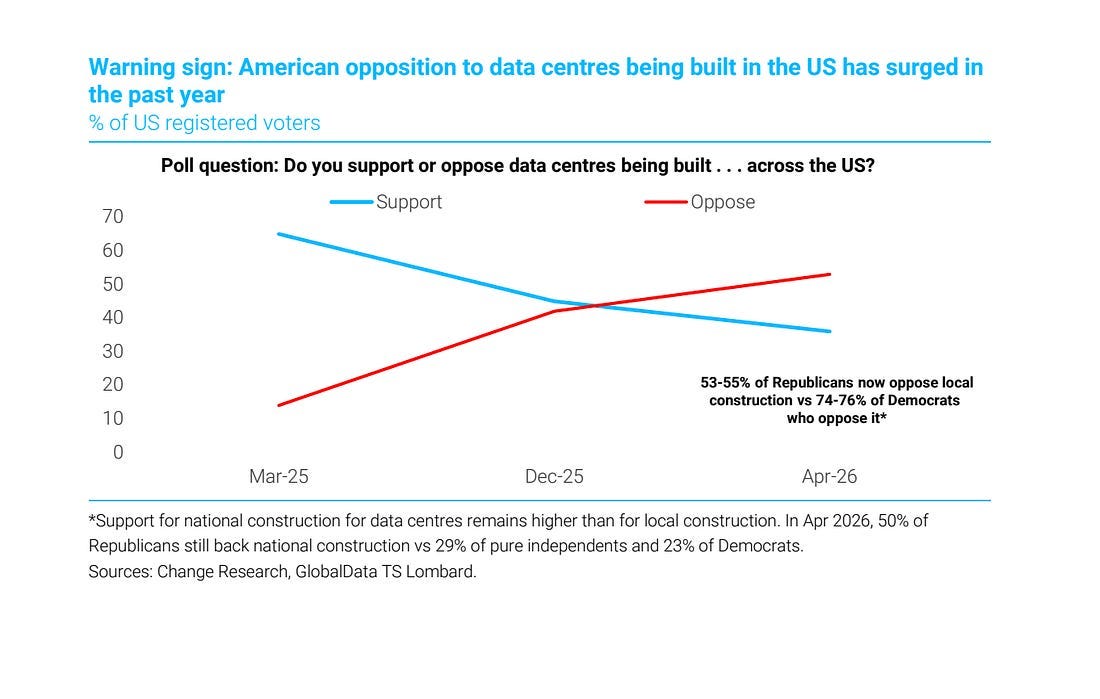
AI and data center investments have been leading the US economy but Maine’s state legislature in April passed a first-in-the-country temporary moratorium on all data centers larger than 20MW until Nov 2027. According to the National Conference of State Legislatures, in 2025, state legislators introduced more than 1,000 AI bills and over 100 laws were enacted by nearly 40 states. This included dozens of towns and counties in 14 states from Missouri to Maryland that implemented data centre moratoriums on the local level. This year, the trend has accelerated - 27 states are now considering legislation targeting “large load” data centers.
(drawn from Grace Fan, TS Lombard, https://hub.tslombard.com/login
Excerpted with edits: https://adamtooze.substack.com/p/top-links-1085-data-center-blowback
5. ELECTRIFICATION OF THE ECONOMY RUNS INTO GRID BUILDOUT
“The Constraints on American Power Supply are Crippling,” Adam Tooze, Chartbook, May 2, 2026
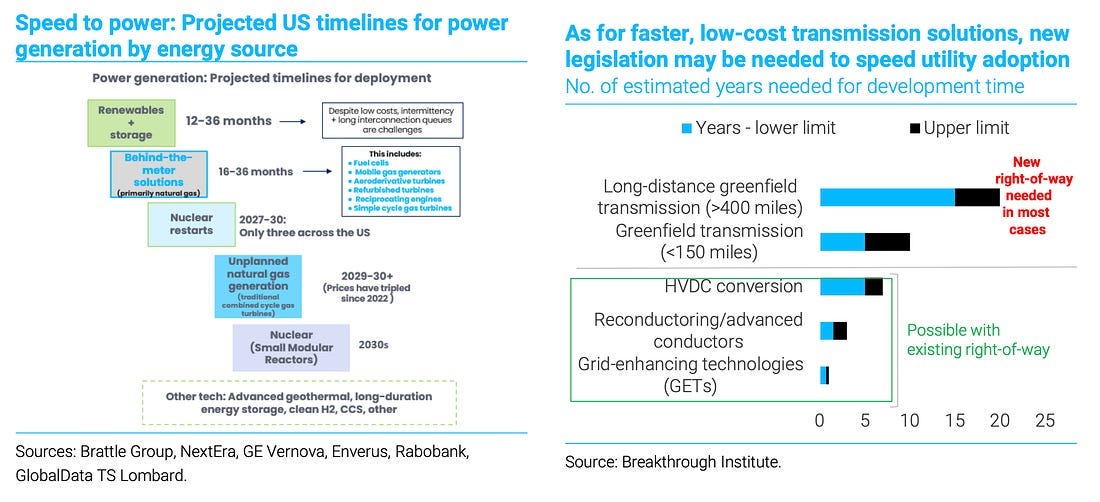
Greenfield transmission line buildout in the US takes seven to 10 years, on average. However, the single biggest obstacle to faster adoption of all of these resources remains disinterest from most investor-owned utilities in pursuing optimized and capital-efficient solutions for two reasons: 1) their economic model guarantees a regulated rate of return on capex but not opex; and 2) they are shielded from competition by a regulated monopoly. Still, with both literal and online pitchforks out for politicians and businesses as electricity bills inexorably climb and costs pile up, utilities are at their most vulnerable in decades to new regulatory interventions and pressure from fed-up voters if they continue to follow outdated business-as-usual practices instead of ripping up past playbooks. This is especially true as utility capex spending has ballooned in recent years, aggravated by the increasing frequency of extreme weather events as well as new capacity demands on top of their capex-first priorities.
(drawn from Grace Fan, TS Lombard, https://hub.tslombard.com/login)
Excerpted with edits from: https://adamtooze.substack.com/p/us-energy-policy-impasse-the-global
EUROPE DEVELOPMENTS:
6. EU COMPETITIVENESS CHALLENGE WITH THE US
“Eurosclerosis 2.0,” P. Wunsch and G. Langenus, National Bank of Belgium report, April 2026
Despite significant well-being growth in the last decades, questions about the relatively less dynamic European economy have resurfaced periodically. In tech industries in particular, Europe lags behind the US, with the most important innovations originating outside the continent. Over the years, European policymakers have tried to address this issue, usually with ambitious multi-year plans. However, these “grand plans” typically overpromised and underdelivered. Economic growth has gradually declined further, and the gap with the US has even widened. Forty years after the launch of the single market, Europe has drifted into Eurosclerosis 2.0.
Europe finds itself, once again, at a pivotal moment. However, while the response to Eurosclerosis 1.0 was a clear paradigm shift from – to put it simply – more activist, government-led economic policies towards market-oriented solutions, economic integration and openness, there is no such movement today. Our economic model is showing cracks under pressure; there are some new emphases and parametric changes here and there, but it is mostly piecemeal. Europe seems to be lacking a consistent approach to dealing with a world that is not moving in its direction and is in fact gradually leaving us behind. In this context, the prevailing inclination is to look for the next “great” European initiative and encourage more integration.
All in all, it seems likely that the current technological wave will ultimately raise productivity across the board, including in Europe despite the latter’s lack of a first-mover advantage. While this will not help to close the relative productivity gap, further widening of the gap should remain limited.
So, does it really matter if Europe is at best a distant third in the technology race? One issue is that first- movers typically produce the leading technology firms, with large profit margins and decision-making centres. Gravitational forces then attract the most talented tech workers from around the world. In addition, innovation ecosystems and networks are created that will likely be at the forefront of the next big technological breakthrough as well. Hence, Europe remains a follower, reliant on non-European suppliers for the technology it needs.
From this perspective, the cost of lagging behind the US might be growing with each wave of technological progress. The US has built a unique tech ecosystem which is becoming increasingly difficult to emulate and is reducing Europe’s capacity to control key technological developments. Europe is ever more in the position of a technology laggard. A key problem in this respect is not innovative capacity per se – this is present in Europe – but rather the speed of change and the transition of start-ups to scale-ups and larger companies. There is no easy solution to this problem.
There is thus a trilemma between the EU’s climate ambitions, openness and the preservation of the single market. Free trade and climate ambitions can be reconciled but, in that case, it will be necessary to prop up firms with national subsidies, a practice which undermines the level playing field in the single market. Alternatively, it is possible to abide by the rules of the single market and adhere to the asymmetric climate objectives but at the cost of constraining free trade. Lastly, both the single market and free trade can be preserved, but only by scaling back climate ambitions, lest energy-intensive industries largely disappear from Europe. In short, it is not possible to achieve all three goals at the same time under the current circumstances.
Trade and competition policies are exclusive powers of the EC. For more than forty years, these policies have been based on clear guidelines that are, to a large extent, at arm’s length from political interference. In other words, the implementation of trade and competition policy is essentially outsourced to civil servants who apply the European consensus; it is a world of “corner solutions”, to use economic jargon, with limited trade-offs. Industrial policies are highly constrained, with the EC pursuing ever more trade integration. This all made perfect sense in a world in which one could trust trading partners and peers to follow rules-based behaviour and, in particular, abide by the Brussels effect. But this world has now disappeared.
Excerpted with edits (paywall): https://www.nbb.be/en/blog/eurosclerosis-20-changing-world-can-europe-once-again-rise-occasion
7. FRANCE WONDERS HOW TO COPE WITH CHINA’S INDUSTRIAL EXPANSION
“In an Impressive Array of Technologies and Sectors, Beijing has Caught Up with and Surpassed the West, Seeking, in Each Case, to Control the Entire Value Chain” (Part 2); “In Thirty Years, China’s El Dorado Has Turned into a Trap for Europe” (Part 4)” Jordan Pouille, Le Monde (from four part article series), April 29, 30, 2026
China is no longer content to simply assemble iPhones or manufacture generic drugs for the rest of the world. It is securing control over the pillars of tomorrow’s economy. It is striving to control the entire value chain. To assert itself on all these fronts at once, Beijing is applying a simple yet relentless strategy: massive research, subsidies targeted at strategic sectors, and control over key raw materials. Advanced economies, having outsourced their production since the 1990s, are discovering with concern their dependence on China for nearly all future technologies.
China is building industrial dominance in a series of sectors: electric vehicles, batteries, renewable energy, drones, nuclear power turnkey solutions, pharmaceutical breakthroughs, food additives, widespread adoption of AI, high-speed rail, and robotic density.
In just a few decades, we have thus moved from “Made in China” to “Invented in China.” And Chinese brands have become new global standards in electric vehicles (BYD, Geely), as well as in smartphones (Huawei) and e-commerce (Alibaba, Shein, Temu). In most sectors, the production cost gaps between the Asian giant and European countries are undeniable, “averaging between 30% and 40%, and [they can] exceed 60% in certain segments,” notes the European High Commission. It is impossible to compete: “Neither moving upmarket, nor productivity gains, nor organizational adjustments can sustainably offset such gaps,” the report further states.
According to these experts, the European Union is generally committed to free markets, but after Trump’s tariffs at “the equivalent of a generalized tariff of around 30%” on Chinese exports across all sectors, some have considered a broader derisking strategy with China. But a harder line solution does not have unanimous support among European governments, even though most of them, like industry players, share the concern and the assessment.
How did we get here? How did we go, in just a few decades, from a China that served as the “world’s factory”—where Western countries relocated their factories to produce goods cheaply and on an assembly-line basis—to a China that poses a “systemic threat” to the future of European competitiveness, to quote the Draghi report published in September 2024? Were European countries naive to think that trading with China would be a win-win situation for everyone, and especially for them? Did they show contempt, certain that the Chinese would never manage to move upmarket and catch up with them, forgetting that this ancient empire was the historical birthplace of the “four great inventions” (the compass, gunpowder, paper, and printing)? Or were they complicit, handing over their know-how to their Asian trading partners
in exchange for colossal productivity gains and a potential market of a billion consumers?
The reality is stark: China has successfully exploited WTO rules to surpass other major powers, and the balance of power with the West has shifted. China’s accession to the WTO is estimated to have cost France nearly 300,000 jobs, a third of them in industry, according to economists’ estimates. Beijing did not follow the trajectory envisioned at the time by Washington or
Brussels. Today, its subsidy-fueled economy dominates the world, and the WTO is paralyzed.
“In hindsight, we should have paid closer attention to regulating subsidies. We knew full well that China was going to develop, but no one imagined it would happen at such a pace,” acknowledges Pascal Lamy, European Commissioner for Trade from 1999 to 2004 and then Director-General of the WTO from 2005 to 2013, who was at the forefront of negotiations with Beijing.
Excerpted with edits: https://www.lemonde.fr/economie/article/2026/04/29/la-toute-puissance-de-la-chine-des-batteries-au-nucleaire-des-medicaments-innovants-aux-additifs-alimentaires-des-tgv-a-l-ia_6684087_3234.html
8. EU EFFORTS TO RUN A COHERENT GREEN INDUSTRIAL STRATEGY HAVE FEW RESULTS
“Europe’s Resistance to Chinese Investment Has Stalled,” Alan Beattie, Financial Times, April 23. 2026
In the European Union, some governments, struggling to build a critical advanced industrial mass and establish independence from a geopolitical rival, see Chinese companies as barbarians inside the gates. In the EU, an expanding toolbox of increasingly powerful instruments to manage those incursions in green technologies, like batteries and EVs, is so far proving ineffective.
European Commission president Ursula von der Leyen has been casting around for effective tools to construct a geopolitical EU. Brussels has tried to reduce Europe’s dependence on China, so far without much effect.
In 2024, the Commission attempted to manage Chinese import penetration of the EU EV market by imposing an array of carefully calibrated anti-subsidy duties. The tariffs were agreed only after a bruising battle between member states, with Germany sceptical because of its own position in the Chinese market.
Noah Barkin of the Rhodium Group consultancy says the strategy has widely been accepted as a failure: “It took over a year, it was hugely divisive, it wasn’t prohibitive for Chinese carmakers and there was retaliation from Beijing,” he says. Indeed, Barkin says recent Chinese investment in the EU has been tempered by the realisation that they can still export to Europe from elsewhere.
Moving from trade to investment, the Commission created the foreign subsidies regulation. This is in theory a very powerful tool authorising invasive investigations into market-distorting state handouts received by foreign companies operating in the EU. But after an initial flurry of investigations in 2024, including dawn raids of a Chinese security scanning company called Nuctech, the investigations are going slowly and without dramatic findings. The Nuctech case took more than 18 months to proceed to a full investigation. In March 2025 the Commission opened its most high-profile case into the Chinese car company BYD and its Hungarian investment, but with no decisions yet. One of the few FSR cases to complete involves an energy company from the United Arab Emirates, which ended up making some fairly modest adjustments to comply.
The newest set of tools to regulate FDI, the Industrial Accelerator Act, is more invasive yet. But again the enthusiasm among some commissioners has run into strong opposition from member states. It’s an open question how and how much a trading bloc like the EU should try to build autonomy from China. It’s clearly a long way from having the political will to do so. Von der Leyen’s “geopolitical Commission” remains an aspiration rather than a reality.
Excerpted with edits (paywall): https://www.ft.com/content/f0820769-294a-4d4e-8282-d76937f3e4ae
CHINA DEVELOPMENTS:
9. CHINA-US TECH SCORECARD
“State of Competition,” Special Competitive Studies Project (SCSP), April 2026
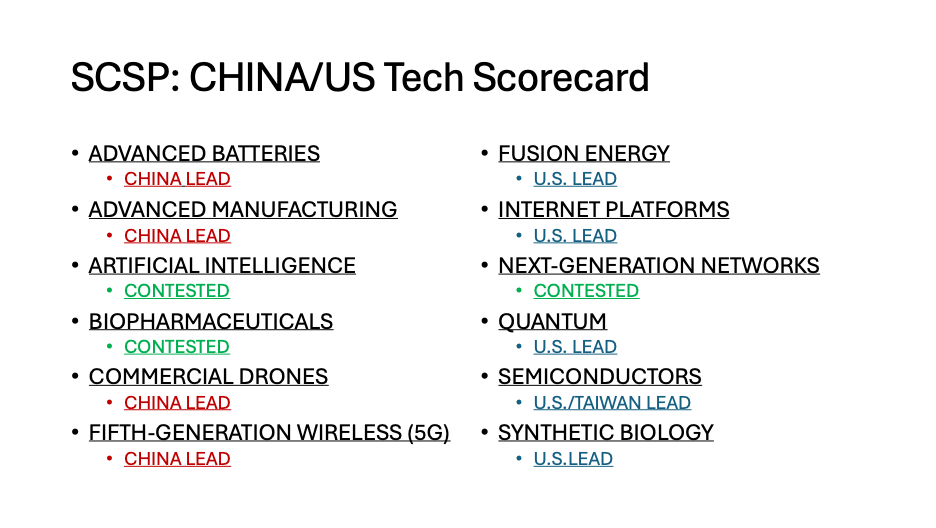
The scorecard follows below - and click on the scorecard link below to see the analysis. Message: China is moving into a lead in batteries, advanced manufacturing, commercial drones and fifth generation wireless (5G), with other key fields (AI, biopharms, next gen networks) contested and it is pushing in other critical fields.
Excerpts with edits: https://scorecard.scsp.ai/scorecard
10. ENGINEERING EDUCATION IN CHINA
“The Giant Leap in the Development of Higher Engineering Education in China,” Zhengyang Wu, ECNU Review of Education (a Sage Journal), November 2024
China now turns out 10X the number of engineers as the US. How did that happen?
Ever since the expansion of higher education enrollment in China, higher engineering education has experienced rapid expansion in scale and quality, leading China toward becoming a prolific global leader in this aspect. Through a series of national engineering educational reforms, such as “Engineering Program Accreditation,” “Outstanding Engineer Plan,” and “New Engineering Construction,” China has sought to improve the quality of engineering talent to “transition from a large state to a powerful state” in higher engineering education. Therefore, this development process can be considered a “golden age” of higher engineering education development in China. Going forward, China’s higher engineering education should focus on continuous quality improvement, strengthen international exchanges and collaboration, and expand into new engineering fields.
Enrollment Growth: Expansion of enrollment in engineering programs across various degree levels was based on a 1998, the Educational Revitalization Action Plan for the Twenty-First Century which was developed to realize the tasks and goals of the cross-century social modernization schemes determined by the 15th National Congress, and ensure the strategy of invigorating China through science and education. This policy set a goal of a higher education gross enrollment rate of 15% for all school-age youth by 2010. This goal was systematically met, with significant expansions particularly in earlier years.
Education Reforms: A core task of higher engineering education in the new era is to cultivate a large base of high-quality engineering science and technology talent with strong innovation capabilities. This led to China’s ability to adapt to its economic and social development needs, and the capacity to help transform it to a leader in engineering education. In recent years, secondary and higher engineering education has undergone a series of reforms, including “Engineering Program Accreditation,” “Outstanding Engineer Education and Training Program,” and “Construction of New Engineering,” intended to improve the training quality of engineering science and technology talent in a holistic manner.
Accreditation: Established in 2005, the National Engineer System Reform Coordination Group led the systematic reform of engineering and launched an engineering education accreditation initiative. After applying for provisional membership in June 2013, China officially joined the Washington Accord in 2016, becoming the eighteenth signatory member. By the end of 2020, 1,600 programs across 257 regular higher education institutions in China had passed the engineering education accreditation, including 22 programs in engineering (e.g., machinery and instruments).
“New Engineering” and Practice Projects: The Ministry of Education (MOE) launched a “new engineering” construction plan in 2017. This was intended to accelerate the design and construction of the new engineering disciplines and majors required for new industries to lead the holistic reform of higher engineering education. To further promote China as an authoritative state in higher education, the government has spared no effort in exploring the construction of higher engineering education in the new era. In 2018, the MOE announced the first batch of 612 new engineering research and practice projects and the second batch of 845 in 2022.
Manufacturing Institutes: To firmly promote the in-depth and extended development of new engineering disciplines and form innovative domains that lead to active breakthroughs, in July 2020, the MOE and the Ministry of Industry and Information Technology (MIIT) jointly issued the Guide to the Construction of Modern Industrial Colleges (for Trial Implementation). This policy is intended to cultivate high-quality, cross-disciplinary, and innovative talent able to adapt to and lead the development of modern industries and put their learned knowledge and skills into practice. It was also decided that a number of modern industry institutes should be co-constructed, managed, and shared between local governments, industry enterprises, and other higher education entities to ensure that these institutes possess distinctive characteristics and close ties to industry.
Numerous higher education institutions have successively established such modern industry institutes. These schools have become an important starting point for local institutions to promote the construction of new engineering disciplines and cultivate high-quality engineering and technical talent. At the end of 2021, the MOE and MIIT announced the first 50 modern industry institutes, including the now-renowned Tencent Cloud Intelligence Research Institute of Shenzhen University. In addition to focusing on talent cultivation, these institutes place considerable focus on the exploration, research, and development of future technologies, closely combining these with engineering talent cultivation.
Excerpted with edits: https://journals.sagepub.com/doi/10.1177/20965311241265731?twclid=217ircwedncdejpwhn4buoacj6

The MIT Initiative for New Manufacturing (INM) aims to redefine what’s possible in manufacturing. Through research, hands-on training, and deep industry collaboration, INM aims to build the tools, systems, and talent to shape a more productive, sustainable, and resilient future. INM is a campus-wide manufacturing effort directed by Professors Suzanne Berger, A. John Hart, Christopher Love and Y. Karen Zheng that convenes industry, government, and non-profit stakeholders with the MIT community to accelerate the transformation of manufacturing.
MIT’s Bill Bonvillian and David Adler edit this Update. We encourage readers to send articles that you think will be of interest to us at mfg-at-mit@mit.edu.
Subscribe to the MIT Initiative for New Manufacturing Substack
Insights from articles and reports of interest on manufacturing technology, management, policy, and economics in the US and abroad